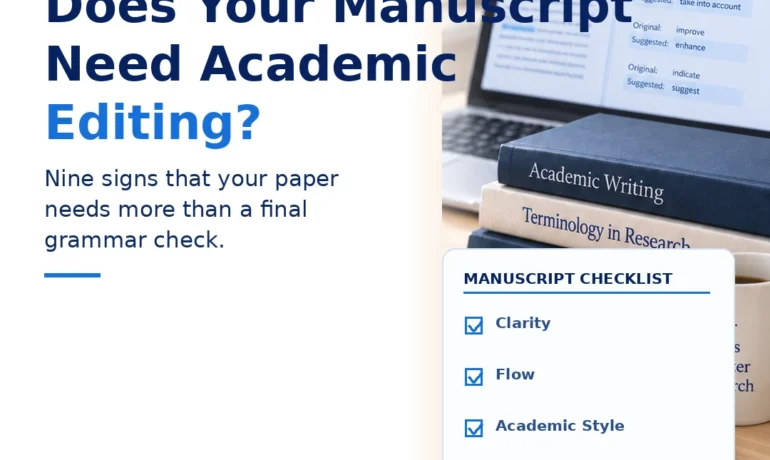
Proofreading can remove many surface-level language errors, but it cannot solve every writing problem. Some manuscripts need more extensive editing because the difficulty lies not in spelling or grammar, but in clarity, structure, flow, and academic style.
If you are deciding between proofreading and academic editing, the following signs can help you judge whether a final language check is likely to be enough.
1. Your sentences are grammatically acceptable but hard to follow
This is one of the clearest signs that proofreading may be too limited. A sentence can be technically correct and still feel dense, indirect, or unnecessarily complicated.
For example, a sentence may contain several clauses, repeated nouns, and weak transitions without containing an obvious grammar error. Proofreading might leave much of that structure intact. Editing would look at how the sentence could communicate the same meaning more efficiently.
2. You regularly use long introductory phrases
Writers working in a second language often build sentences with long openings such as “It is important to note that,” “It can clearly be seen that,” or “In terms of the results obtained in the present study.” These phrases are not always wrong, but repeated use can make the manuscript feel heavy and indirect.
Academic editing can reduce this type of wordiness while preserving the intended emphasis.
3. Paragraphs feel like lists of sentences rather than arguments
A paragraph should normally develop one central idea. If sentences are individually understandable but the connection between them is weak, the problem is larger than proofreading.
An editor may improve transitions, adjust sentence order within the limits of the agreed service, and help the paragraph read as a coherent unit rather than a sequence of separate statements.
4. The same idea is repeated several times
Repetition is common in academic drafts, especially when authors revise sections at different times. A point may appear in the final sentence of one paragraph and then be repeated almost unchanged at the beginning of the next.
Proofreading usually does not remove substantial repetition unless it creates an obvious language problem. Editing is better suited to identifying unnecessary duplication and tightening the prose.
5. The manuscript sounds translated
A text can be accurate and grammatically correct but still sound as if it has been transferred directly from another language. Common signs include unusual word order, literal collocations, excessive nominalization, repeated passive structures, and expressions that are understandable but not typical of published academic English.
This is especially common after translation. If the scientific meaning is correct but the language still feels mechanical or unnatural, academic editing may be the right next step.
6. Terminology changes without a clear reason
Inconsistent terminology can make readers wonder whether two expressions refer to the same concept. For example, a paper may alternate between “customer loyalty,” “consumer loyalty,” and “client loyalty” even though only one construct is being measured.
An editor familiar with the field can flag these shifts and improve consistency while respecting the author’s preferred terminology.
7. Reviewers have commented on readability or style
Comments such as “the English requires substantial improvement,” “the manuscript is difficult to follow,” or “the paper would benefit from professional language editing” usually indicate more than isolated grammar errors.
In those cases, a basic proofread may not fully address the reviewer’s concern. The manuscript may require sentence-level restructuring and broader improvements to clarity and academic tone.
8. Your abstract does not read as smoothly as published abstracts in your field
The abstract is often the most language-sensitive section of a manuscript because it compresses the research question, method, findings, and conclusion into a small space. Wordiness, vague verbs, and weak transitions become especially noticeable.
If the abstract feels difficult to shorten without losing meaning, or if the sentences do not sound natural despite being grammatically correct, editing may help.
9. You are frequently unsure whether a phrase is academically natural
If you repeatedly ask yourself whether an expression “sounds academic,” that uncertainty may point to a broader style issue. Academic English is not simply formal English. It relies on discipline-specific patterns of phrasing, appropriate caution, concise argumentation, and consistent terminology.
Editing can help align the language with those conventions without making every sentence sound artificially complex.
What academic editing should not do
Editing should improve expression, not invent content. A responsible editor should preserve citations, data, statistical values, and the strength of scientific claims. A cautious statement such as “may be associated with” should not be rewritten as “causes” unless the author’s evidence and intended meaning support that change.
The objective is clearer communication of the author’s work, not replacement of the author’s scientific judgment.
How to choose the right level of support
If the manuscript is already clear and mainly contains occasional errors, proofreading is probably sufficient. If the English affects readability, flow, academic tone, or sentence structure, editing is usually the more appropriate choice.
You can also read our comparison of proofreading vs. editing for a more detailed explanation of the difference.
Unsure which service fits your manuscript? Submit the file through our Get a Quote page. We can assess the manuscript’s current language quality before confirming the service, scope, delivery date, and price.
