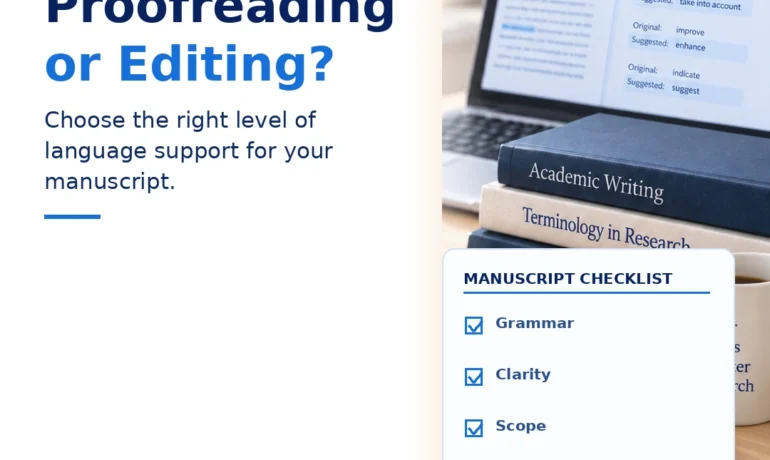
One of the most common questions researchers ask before submitting a manuscript is simple: Do I need proofreading or editing? The two services overlap, but they solve different problems. Choosing the wrong level of support can mean paying for work you do not need, or submitting a manuscript that still has language and readability problems after a basic proofread.
The best choice depends less on how many errors a manuscript contains and more on what kind of language support the manuscript needs. A paper with strong academic English may only need a final language check. A paper with grammatically correct sentences can still need editing if the argument feels difficult to follow, terminology shifts from section to section, or the writing sounds translated rather than naturally academic.
What academic proofreading is designed to fix
Academic proofreading is usually the final language stage before submission. It is most appropriate when the manuscript is already structurally sound and the English is generally clear.
A professional proofreader typically focuses on issues such as:
- grammar and sentence-level errors
- spelling and punctuation
- articles, prepositions, verb forms, and agreement
- word choice where the intended meaning is already clear
- terminology consistency
- capitalization, abbreviations, and basic style consistency
- awkward or distracting wording that can be corrected without substantial rewriting
Proofreading is therefore a good fit for authors who can read their own manuscript and say, “The argument and structure are where I want them. I need a careful final language review.”
What academic editing does differently
Academic editing goes beyond correcting language errors. It looks at how effectively the English communicates the research.
An editor may revise sentence structure, reduce unnecessary repetition, improve transitions, strengthen academic tone, clarify dense passages, and make terminology more consistent. Academic editing should improve clarity and readability without altering the author’s research or scientific claims.
This distinction matters because a manuscript can be grammatically correct and still be difficult to read. For example:
Before editing: “The results obtained in the present study show that there are a number of factors which can have an effect on the outcome and these factors may also be related with each other.”
After editing: “The present findings indicate that several factors may influence the outcome and may also be interrelated.”
The first sentence is not incomprehensible. Its main problem is wordiness, weak structure, and unnatural academic phrasing. That is an editing issue rather than a simple proofreading issue.
Five signs that proofreading is probably enough
- Your manuscript has already been edited by a writer proficient in academic English. You mainly want a final check before submission.
- Most sentences are already clear on the first reading. Errors are occasional rather than systematic.
- Your terminology is stable throughout the paper. The same concepts are not described with several competing terms.
- You are satisfied with paragraph structure and logical flow. You do not expect the language professional to reorganize or substantially reshape sentences.
- A journal or coauthor has requested a final language check rather than extensive language revision.
Five signs that academic editing is more appropriate
- Your sentences are often long, dense, or indirect.
- The manuscript contains repeated phrases or ideas.
- You can understand the English, but it does not sound natural to you.
- Reviewers have previously commented on clarity, readability, or academic style.
- The manuscript was translated into English and has not yet been reviewed for natural academic phrasing.
In these situations, proofreading alone may correct surface errors while leaving the deeper readability problem intact.
What if you are not sure?
It can be difficult to judge your own manuscript’s language needs, especially after several rounds of revision. Authors who know the subject matter well may read past unclear wording because they already know what each sentence is intended to mean.
A useful assessment should therefore consider the manuscript itself, not simply the author’s description of it. At CertifiedEditing, the requested service can be evaluated against the current language quality of the manuscript. If a manuscript only needs proofreading, there is no reason to recommend a more extensive service. If basic proofreading would leave important clarity problems unresolved, that should be explained before work begins.
Does editing change the scientific content?
It should not. Responsible academic editing improves how the research is expressed while preserving the author’s scientific meaning, numerical information, citations, and level of claim. Editors should not strengthen a conclusion beyond what the data support or introduce new interpretations simply because a stronger sentence sounds better.
This is particularly important in technical and medical writing, where a small wording change can alter the strength, scope, or certainty of a claim.
Which service is better before journal submission?
There is no universal answer. The right service is the least extensive service that fully addresses the manuscript’s language needs.
If your manuscript is already strong and needs a final quality check, proofreading is usually appropriate. If the English is affecting clarity, flow, style, or readability, editing is the more suitable option. Some manuscripts sit between the two, which is why reviewing the file before confirming the service can be valuable.
Need help choosing? You can upload your manuscript through our Get a Quote page. We will review the material you submit and confirm the appropriate service, scope, delivery time, and price before any work begins.
Related reading
You may also find our guides on what academic proofreading includes and signs that a manuscript needs academic editing useful when deciding how much language support your paper requires.
