
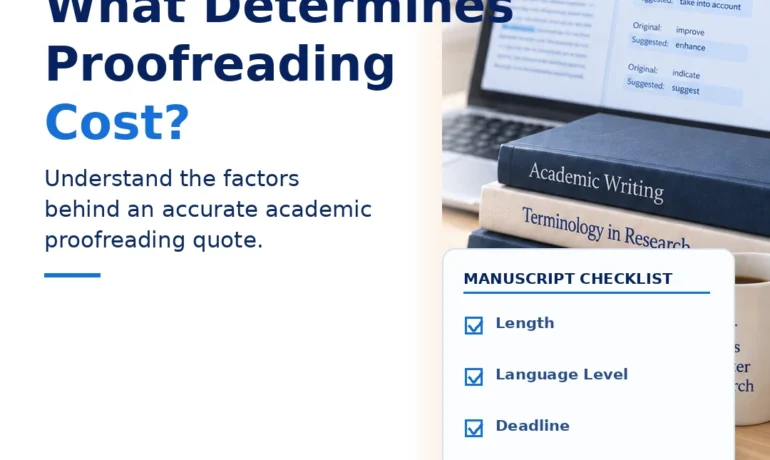
If you are preparing a manuscript for journal submission, one of the first practical questions is often: How much does academic proofreading cost? The short answer is that there is no single price that applies to every manuscript.
That is not because pricing is arbitrary. A 3,000-word paper written in strong English does not require the same amount of work as an 8,000-word manuscript with dense technical language, inconsistent terminology, and a 48-hour deadline. A meaningful quotation should therefore reflect the actual workload rather than rely on one number alone.
1. Manuscript length
Length is the most obvious pricing factor. Longer manuscripts require more reading, correction, consistency checking, and final review. Some services calculate by word count, while others use character count or document length.
Length matters, but it should not be the only factor. Two manuscripts with the same word count can require very different amounts of work.
2. Current language quality
The starting quality of the English has a major effect on cost. A manuscript that is already clear and grammatically strong may need only a light final review. Another paper of the same length may contain systematic grammar problems, awkward sentence structures, repeated terminology inconsistencies, and unclear phrasing.
This is why a manuscript assessment is more useful than pricing based on word count alone. If the file actually requires academic editing rather than simple proofreading, quoting it as proofreading can create unrealistic expectations for both the author and the editor.
3. Academic field
Discipline matters because terminology matters. Proofreading a manuscript in sociology is not identical to reviewing a cardiology paper, a machine learning study, or a legal analysis.
Highly specialized fields may require an editor who understands technical vocabulary, common phraseology, notation, and the conventions of that literature. Subject matching can therefore affect the amount of expertise required for the job.
4. Type of service
Proofreading and editing should not be priced as if they were the same task. Proofreading focuses on final language accuracy, consistency, and readability. Editing is more extensive and may involve sentence restructuring, academic style, flow, concision, and more substantial work on clarity.
If you are comparing quotes, make sure you are comparing equivalent scopes. A lower price may simply reflect a narrower service.
5. Delivery time
Urgent work usually costs more because it requires the service provider to reserve editor capacity and reorganize the production schedule. A 48-hour request for an eligible manuscript is fundamentally different from a flexible deadline several days away.
If your deadline is not fixed, allowing more time can make scheduling easier and may reduce the need for urgent-service pricing.
6. Additional requirements
Some manuscripts come with extra instructions. These may include journal-specific language requirements, a response letter that needs to be checked alongside the manuscript, a request for British or American English consistency, or a need to review terminology against the author’s preferred usage.
These details can affect the amount of work involved, which is why they should be included when requesting a quote.
7. Quality-control process
Price also reflects how the service is delivered. A basic one-pass correction is not equivalent to a workflow that includes subject matching, an independent review stage, final quality assurance, revision support, and documented language review.
When comparing prices, ask what happens after the first editor finishes. Is there a second review? Are post-delivery language revisions available if a journal raises language-related comments? Is the manuscript handled by editors familiar with the field?
Why the cheapest quote is not always the least expensive option
A low-cost proofread can become expensive if the manuscript later requires a second service because important language problems were left unresolved. The same is true at the other extreme. Paying for comprehensive editing when the paper only needs light proofreading is unnecessary.
The most economical choice is usually the right level of support, not automatically the lowest or highest-priced service.
What should a clear quotation include?
Before approving a service, you should know:
- which service is being recommended
- what the service will and will not cover
- the confirmed total price
- the expected delivery date
- whether taxes are included
- what revision support is available after delivery
A quotation should make it possible to compare scope as well as price.
Can you get a quote before committing to an order?
Yes. A quotation should not obligate you to place an order. At CertifiedEditing, the manuscript and request details are reviewed before the scope, delivery time, and total cost are confirmed. Work begins only after you approve the quotation.
Want an exact price for your manuscript? Upload your file through our Get a Quote page. The quote is based on document length, current language quality, academic field, service type, and requested delivery time.
If you are still deciding between proofreading and editing, read our guide to academic proofreading vs. editing before requesting your assessment.
