
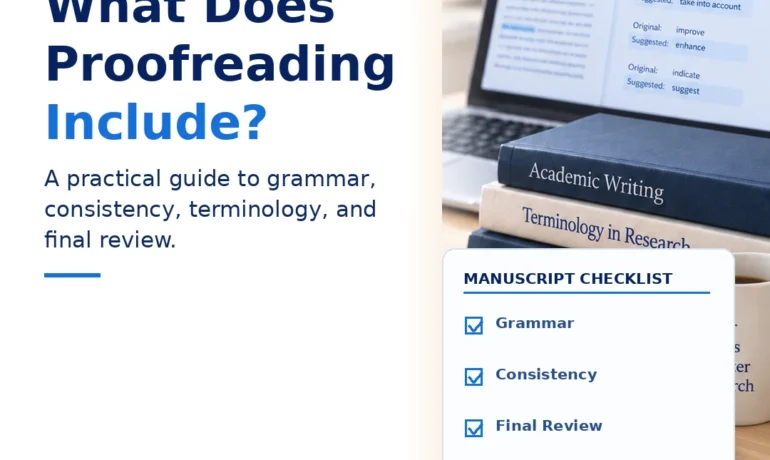
Academic proofreading is often described as the final language check before submission, but that description can be too vague to help a researcher decide whether the service is sufficient. A good proofreading service should do much more than correct obvious spelling mistakes. At the same time, it should not expand into more extensive editing without a clear change in scope or alter the author’s scientific meaning.
The most useful way to understand proofreading is to look at the level of language support. Academic proofreading is designed for manuscripts whose argument, structure, and overall language are already in good condition. The proofreader works at the sentence level while also checking consistency across the manuscript, so language problems do not distract from the research.
Grammar and sentence-level accuracy
The first layer is grammatical accuracy. This includes subject–verb agreement, verb tense, articles, prepositions, pronouns, singular and plural forms, sentence fragments, and other sentence-level errors. In academic writing, these details matter because repeated small errors can make a manuscript appear less polished even when the research itself is strong.
A proofreader should also notice errors that automated tools often miss because the sentence is technically possible but incorrect in context. For example, “evidence supports to the hypothesis” may not trigger every basic spellchecker, yet the construction is not standard English.
Punctuation, spelling, and capitalization
Academic manuscripts contain many punctuation decisions that affect readability. Commas, colons, semicolons, hyphens, parentheses, quotation marks, and apostrophes should be used consistently. Spelling should also follow the requested variety of English, such as American or British English, rather than switching between the two.
Capitalization is another common source of inconsistency. Terms used in headings, variable names, disease names, methodological labels, and proper nouns should follow a coherent pattern.
Terminology consistency
Terminology is especially important in scientific and technical writing. A manuscript may use “participants” in one section, “subjects” in another, and “respondents” elsewhere even though the same group is being discussed. In some fields those terms are not fully interchangeable.
Proofreading should identify this type of inconsistency and help keep terminology stable where the author’s intended meaning is clear. When a term is discipline-specific or potentially ambiguous, the proofreader should avoid guessing.
Word choice and natural phrasing
Proofreading can include limited improvements to word choice and phrasing when the intended meaning is obvious. For instance, an unnatural collocation such as “make an analysis” may be corrected to “conduct an analysis.”
What proofreading should not do is extensively reconstruct paragraphs, reframe the argument, or substantially rewrite sentences throughout the paper. If those changes are necessary, the manuscript is moving into academic editing territory.
Consistency across the manuscript
A strong proofreader reads beyond individual sentences. They also check whether recurring elements are presented consistently throughout the paper. Depending on the manuscript, this may include:
- abbreviations and their first use
- hyphenation and capitalization
- numbers, units, and symbols
- headings and subheadings
- table and figure references
- statistical notation where language consistency is involved
- preferred spelling and terminology
This type of consistency review is one reason professional proofreading is different from simply running the document through a grammar tool.
Readability without changing content
Proofreading may improve minor readability problems, but the scientific message should remain unchanged. The proofreader should not introduce stronger causal language, change the scope of a finding, or rewrite a cautious conclusion as a definitive statement.
For example, “may be associated with” should not become “causes” simply because the second version is shorter. In academic work, precision is more important than stylistic force.
What is usually not included in proofreading?
Unless specifically agreed in advance, proofreading does not normally include major restructuring, literature review development, statistical analysis, reference verification against external databases, journal selection, rewriting of scientific content, or extensive translation from another language.
If a manuscript requires substantial work on sentence structure, paragraph flow, academic tone, and clarity, editing is usually the more appropriate service. If the source text is in another language, the work should be handled as academic translation rather than proofreading.
When should proofreading happen?
Proofreading is most efficient after the author has completed substantive revisions. If major sections are still being added or deleted, proofreading too early can mean paying to review text that will later disappear.
A good point to request proofreading is when:
- the research content is stable
- the coauthors have completed their main revisions
- the target journal has been selected
- the manuscript is close to submission
What should you receive at the end?
You should receive a manuscript in which the agreed language corrections are clearly reflected. Depending on the workflow, tracked changes may also be provided so that you can review the revisions. If a journal requires evidence of professional language review, ask whether the service can provide appropriate documentation.
For eligible completed services, CertifiedEditing can provide a QR-verifiable language certificate and a complimentary iThenticate similarity check. The certificate documents professional language review, while the iThenticate check provides a similarity report. Neither guarantees journal acceptance.
Is proofreading enough for your manuscript? Upload the file through our Get a Quote page. We can review its current language quality and let you know whether proofreading is sufficient or whether more extensive academic editing would be more appropriate.
