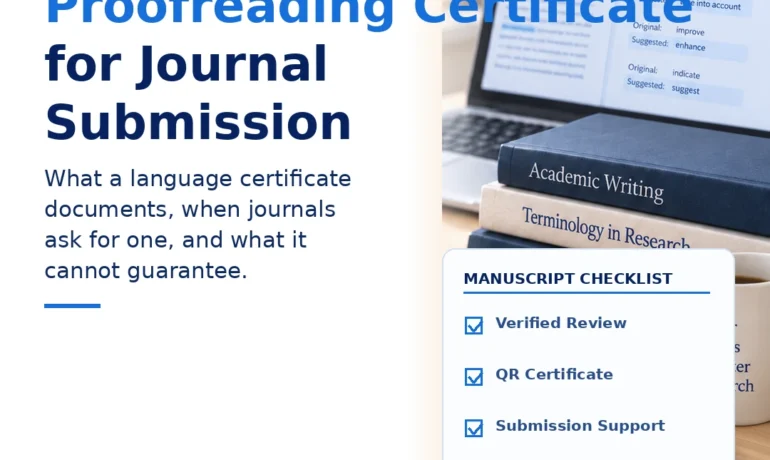
Some journals ask authors to improve the English before submission or resubmission. In certain cases, the editorial office may also ask for evidence that the manuscript has undergone professional language review. This is where a proofreading or language editing certificate can be useful.
A language certificate documents that a manuscript has undergone professional language review. It should not be presented as proof that the paper will be accepted, that the research is scientifically valid, or that the journal has endorsed the service provider.
What is a proofreading certificate?
A proofreading certificate is a document issued after completion of a language-review service. Depending on the provider and the service performed, it may identify the manuscript, the type of language review, the completion date, and the organization that carried out the work.
Its purpose is to document that professional language review has taken place.
Why might a journal ask for one?
Journals receive manuscripts from researchers around the world. When the English is difficult to follow, an editor may ask the authors to have the paper professionally reviewed before the next editorial stage.
In some cases, the journal simply asks for improved English. In others, the author may be asked to provide a certificate or confirmation from a professional language service.
The exact requirement depends on the journal, so always read the decision letter and author instructions carefully.
What should the certificate actually confirm?
A useful certificate should accurately describe the completed service. It may state that the manuscript underwent professional academic proofreading or editing for areas such as grammar, clarity, consistency, terminology, and academic language.
The wording should match the service that was genuinely provided. A light proofread should not be described as comprehensive academic editing if that work was not performed.
What a proofreading certificate does not mean
A certificate does not mean:
- the journal will accept the manuscript
- the research has been peer reviewed
- the methodology has been validated
- the references have all been independently verified
- the manuscript is guaranteed to be error-free
- the service provider is affiliated with the target journal
Journal acceptance depends on many factors beyond language, including originality, methodology, scientific contribution, journal fit, editorial priorities, and peer review.
Is a certificate the same as proofreading?
No. The certificate is only documentation of the service. The value lies in the quality of the underlying language review.
If the manuscript needs more substantial improvements to sentence structure, readability, and academic style, a certificate issued after superficial proofreading will not solve the underlying problem. The first priority should be choosing the appropriate level of language support.
If you are unsure whether your file needs proofreading or academic editing, the manuscript itself should be assessed before the work begins.
When should you request the certificate?
If your target journal explicitly asks for language-review documentation, tell the service provider before placing the order. This allows them to confirm whether a certificate is available for the requested service.
You may also request one proactively if you know from the journal’s instructions that professional language documentation is expected.
What is a QR-verifiable language certificate?
A QR-verifiable certificate includes a code that can be used to check the document’s authenticity or related verification information. This can be more practical than a static PDF because the recipient can confirm that the certificate was genuinely issued by the service provider.
CertifiedEditing can provide a QR-verifiable language certificate for eligible completed services. The certificate documents professional language review, while individual journals and editorial offices determine what documentation they accept.
What if the journal asks for language improvement after you already received a certificate?
A certificate does not prevent a reviewer or editor from requesting additional revision. New text may have been added after the original review, or the journal may identify passages that require further clarification.
If the underlying manuscript has not been materially changed, post-delivery language revision support may cover language-related requests within the original service scope.
At CertifiedEditing, free language revision is available after journal reviewer or editor requests when the original content has not been materially changed and the request remains within the agreed language-service scope.
Should every manuscript have a certificate?
No. Many journals never ask for one. If your target journal does not require documentation, the certificate is optional.
The most important outcome is still a manuscript whose English is clear, accurate, consistent, and appropriate for academic publication.
What should you send when requesting language review?
To obtain an accurate assessment, provide the manuscript, target journal if known, required delivery date, and any relevant editor or reviewer comments. If the journal has specifically requested a certificate, include that information as well.
Need professional language review with documentation? Submit your manuscript through our Get a Quote page. We will review the file, confirm the appropriate service, and let you know whether QR-verifiable language certification applies to your project before work begins.
If your journal has already requested language improvement, see our guide on what to do when a journal says the English needs improvement.
