
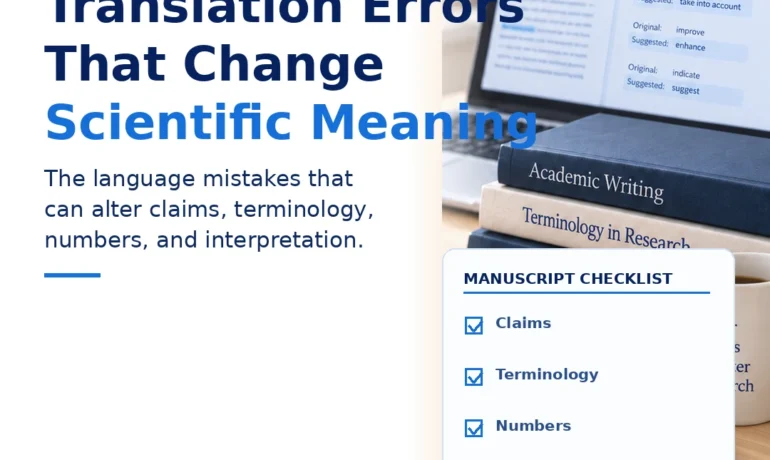
In academic translation, the most serious errors are not always the most obvious ones. A sentence can be grammatically correct and fluent while still misrepresenting the source. That is why academic translation should be evaluated not only for language quality but also for the accurate transfer of scientific meaning.
The following problems are especially important because they can alter how readers understand the study.
1. Changing the strength of a claim
Words that express certainty are critical in research writing. “May,” “might,” “suggests,” “indicates,” “demonstrates,” and “proves” do not communicate the same level of confidence.
If a source sentence says that a variable “may be associated with” an outcome, translating it as “causes” that outcome changes the scientific meaning. The English may sound stronger, but it is no longer faithful to the source.
2. Using a dictionary equivalent instead of the field-specific term
Many technical expressions have several possible translations. The correct choice depends on how the concept is used in the relevant English-language literature.
For example, a direct dictionary equivalent may sound reasonable to a general translator but be uncommon or misleading in medicine, engineering, law, education, or economics.
This is why academic translation should use terminology choices informed by the relevant academic field rather than isolated word replacement.
3. Translating one source term in several different ways
Terminology inconsistency is more than a style issue. If one construct is translated with three different English terms, readers may think the manuscript refers to three distinct concepts.
Key variables, methods, participant groups, interventions, and theoretical concepts should be tracked consistently across the abstract, main text, tables, and figures.
4. Translating sentence structure too literally
A translation may retain source-language syntax even when every individual word has been translated correctly. The result may contain unusual word order, overly long noun phrases, repeated connectors, or ambiguous references.
A good academic translation should preserve meaning without preserving source-language structure when that structure produces unnatural or unclear English.
5. Losing the relationship between cause, association, and prediction
Research papers often distinguish carefully between variables that are associated, predictive, explanatory, mediating, moderating, or causal.
These distinctions can be lost if the translator chooses a general verb such as “affects” for several different relationships. In statistical and methodological writing, this can materially change interpretation.
6. Misreading negative or restrictive expressions
Expressions such as “not necessarily,” “only when,” “unless,” “no significant difference,” and “cannot be excluded” carry precise logical meaning. A small translation error can reverse or weaken the statement.
Negative findings deserve particularly careful review because a missing “not” or an incorrectly translated qualifier can create the opposite conclusion.
7. Changing tense in a way that changes meaning
Tense choices in academic writing often indicate whether a statement refers to established knowledge, the present study’s procedure, or a completed finding.
For example, methods are commonly described in the past tense, while established facts may be written in the present tense. A translation that changes tense mechanically can blur this distinction.
8. Altering numerical or statistical information during language revision
Numbers are not translated, but they can be accidentally changed when sentences are rewritten. Decimal points, confidence intervals, p-values, percentages, sample sizes, and table references should remain identical unless the author has explicitly revised them.
A robust workflow should include a final quality check that compares critical numerical information against the source.
9. Expanding abbreviations incorrectly
Abbreviations can be discipline-specific and sometimes have multiple meanings. Guessing an expansion is risky.
If the source does not make an abbreviation clear, the translator should verify it from context or ask the author rather than invent an interpretation.
10. Making the conclusion more persuasive than the data allow
Translators and editors naturally want the English to sound strong. In academic writing, however, stronger is not always better.
A cautious conclusion may reflect a small sample, observational design, limited generalizability, or non-significant findings. The translation should preserve that restraint.
How can these errors be prevented?
A reliable academic translation process should combine several safeguards:
- subject-matter matching
- consistent terminology management
- careful preservation of claim strength
- independent academic English editing after translation
- final checks of citations, numbers, abbreviations, and key terms
- clarification of ambiguous source passages rather than guessing
A strong academic translation communicates the author’s research accurately, naturally, and consistently without making the claims sound stronger than the source supports.
Translation and editing should be separate stages
A translator may become familiar with the source and therefore overlook English that remains slightly literal. A separate editor can review the translated manuscript as an English academic text and improve flow, clarity, and natural phrasing while protecting the original meaning.
This is one reason multi-stage review is valuable for manuscripts intended for international journals.
Concerned about terminology or meaning in an English translation? You can submit the source manuscript through our Get a Quote page. We will assess the academic field, language direction, document length, and required level of review before confirming the scope.
For broader guidance, see our articles on academic translation for journal submission and choosing an academic translation service.
