
Researchers often begin by comparing academic translation services on price and turnaround time. Those factors matter, but they do not tell you whether the final English manuscript will preserve your scientific meaning, use the correct terminology, and read naturally enough for journal submission.
An academic manuscript is not a generic document. It contains discipline-specific concepts, methodological language, cautious claims, and many details that should not be altered during translation. Choosing the right service therefore requires a closer look at the workflow behind the quote.
1. Ask whether translators are matched to the academic field
A translator can have excellent general English and still struggle with specialized terminology. Medical, engineering, legal, economic, educational, and social-science manuscripts each use their own conventions and recurring expressions.
A suitable academic translation service should match the manuscript with a translator who has relevant subject expertise. Subject familiarity reduces the risk of selecting a technically possible but academically inappropriate equivalent.
2. Look for terminology consistency, not just fluent English
A polished translation can still be scientifically confusing if key terms change from section to section. The same construct, variable, intervention, or participant group should not be described with several different terms unless the distinction is intentional.
Ask how the service handles terminology. If your field has preferred translations, acronyms, or established English equivalents, provide them before work begins.
3. Find out whether the translation is independently edited
Translation and editing are different tasks. A translator focuses on accurate transfer of meaning. An editor reviews whether the resulting English is clear, natural, consistent, and appropriate for academic publication.
A service that delivers the translator’s first draft without a separate language review may leave literal phrasing or source-language structures in the final text.
Ideally, the workflow should include translation followed by independent academic editing and a final quality check.
4. Ask how scientific claims are protected
One of the most serious translation risks is a change in claim strength. “May contribute to,” “is associated with,” and “causes” are not interchangeable expressions.
The service should preserve hedging, uncertainty, and methodological caution. A more forceful English sentence is not necessarily a better translation if it overstates what the source says.
5. Check how numbers, citations, and technical elements are handled
Academic translation should protect numerical values, citations, statistical notation, table and figure references, units, and abbreviations. These elements may not require translation, but they can still be accidentally altered during editing.
A reliable workflow should include a final check that the translated file still matches the source in these areas.
6. Review the confidentiality policy
Academic manuscripts may contain unpublished findings, identifiable data, commercial information, or research that is still under peer review. Before uploading a file, check how the service handles confidentiality and who can access the manuscript.
You should know whether access is restricted to the professionals assigned to the project and whether file transfer is protected appropriately.
7. Ask what happens after delivery
Language work does not always end when the first file is returned. A journal may later request a language revision, or the author may notice a passage that requires clarification.
Ask whether post-delivery language revisions are included and under what conditions. At CertifiedEditing, free language revision is available after journal reviewer or editor requests when the original content has not been materially changed and the request falls within the original language-service scope.
8. Do not treat a certificate as a guarantee
Some journals ask authors to document that a manuscript has received professional language review. A service may provide a language certificate for this purpose.
The important distinction is that a language certificate documents a completed language service. It does not guarantee acceptance, indexing, or publication.
CertifiedEditing can provide a QR-verifiable language certificate for eligible completed services.
9. Compare the scope behind the price
Two quotes can look very different because they include different levels of work. One may cover translation only. Another may include translation, academic editing, proofreading, and final quality assurance.
Before comparing prices, ask exactly what is included. A lower initial price may not be economical if the translated manuscript later needs a separate editing service.
10. Look for a clear assessment before the work begins
A quotation should explain the service, scope, delivery date, and total price before you approve the order. The provider should also ask for the manuscript, academic field, target journal if known, and deadline.
That information allows the project to be matched to the right professional and helps prevent misunderstandings about what the service will cover.
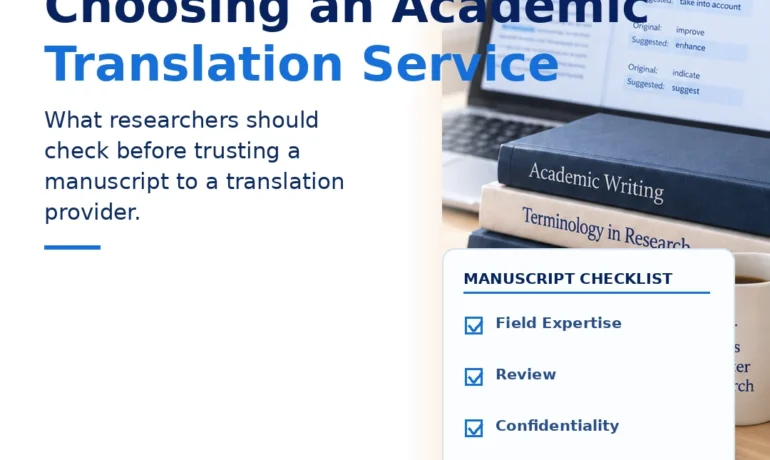
A practical checklist
Before choosing an academic translation service, ask:
- Will the translator be matched to my field?
- Is terminology consistency reviewed?
- Does a separate editor review the English?
- Are scientific claims and numerical information protected?
- How is confidentiality handled?
- What post-delivery revision support is included?
- Can the service document professional language review if needed?
- Is the total scope clear before I approve the quote?
Need a translation assessment for your manuscript? Submit the source file through our Get a Quote page. We will review the manuscript and confirm the recommended scope, delivery date, and total price before work begins.
You can also read what quality means in academic translation for journal submission before comparing providers.
