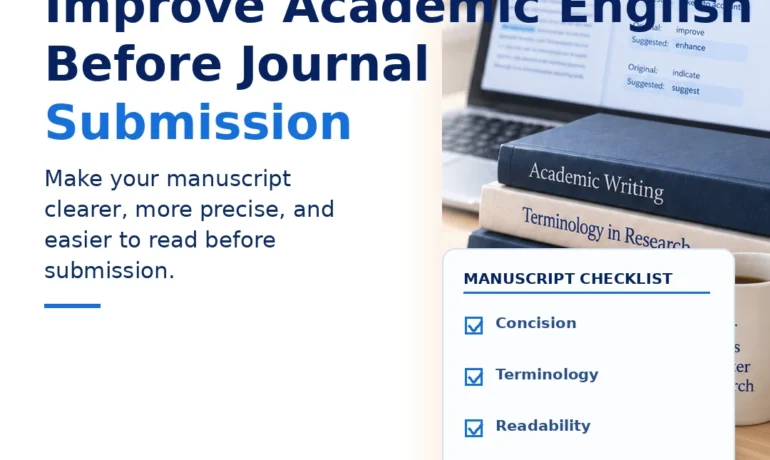
Many manuscripts are scientifically complete before the English is ready for submission. The data are complete, the figures are final, and the argument is established, yet language problems can still make the paper harder to read than it needs to be.
Improving academic English before journal submission does not mean making every sentence longer or more formal. In fact, effective academic writing is usually clearer, more precise, and more economical than an early draft.
Start by checking whether each sentence has one clear job
Long sentences often become difficult because they try to introduce background, describe a method, interpret a result, and add a limitation at the same time. If a sentence contains several independent ideas, consider whether it should be divided.
A useful test is to ask: What is the main point of this sentence? If the answer is difficult to identify, the sentence may need restructuring.
Reduce unnecessary opening phrases
Academic manuscripts often contain phrases such as “It is important to note that,” “It can be clearly seen that,” or “In the context of the present study.” These expressions are sometimes useful, but frequent use adds length without adding meaning.
Compare:
Wordier: “It can be clearly seen from the results that the intervention significantly reduced symptom severity.”
Clearer: “The results show that the intervention significantly reduced symptom severity.”
The second version communicates the same point more directly.
Use terminology consistently
Terminology shifts can confuse readers even when the language is otherwise strong. Decide which term you will use for key variables, participant groups, interventions, methods, and outcomes, then check that the same term is used throughout the manuscript unless a change is scientifically necessary.
This is especially important in translated manuscripts, where several English equivalents may have been used for one source-language term.
Check the strength of your claims
Academic English is not only about grammar. It is also about matching language strength to evidence. Words such as “proves,” “causes,” “demonstrates,” “suggests,” “indicates,” and “may be associated with” carry different levels of certainty.
Before submission, check whether conclusions are expressed at the same level of confidence supported by the design and results. Language editing should never make a claim stronger merely because a stronger verb sounds more persuasive.
Make paragraph logic visible
A strong paragraph usually has a clear internal direction. The first sentence introduces the point, the middle sentences develop it, and the final sentence often explains its significance or connects it to the next idea.
If your paragraph contains good information but feels difficult to follow, look at the transitions between sentences. Words such as “however,” “therefore,” “in contrast,” and “in addition” can help, but only when they reflect a real logical relationship. Adding transition words mechanically will not fix weak paragraph structure.
Check common second-language patterns
Some language problems appear repeatedly in manuscripts written by researchers writing in English as an additional language. Common examples include:
- overuse of passive voice where an active construction would be clearer
- literal translation of collocations
- unnecessary repetition of nouns instead of using pronouns or restructuring
- article errors with “a,” “an,” and “the”
- incorrect prepositions
- very long noun phrases
- switching between American and British spelling
These issues do not make a manuscript scientifically weak, but they can make reading slower and distract attention from the research.
Read the abstract separately
The abstract deserves its own language review. Because it is short and information-dense, awkward phrasing becomes more visible there than in other sections.
Check whether the abstract clearly communicates the background, objective, method, main findings, and conclusion without repeating information unnecessarily. Avoid spending too many words on general background if the journal’s abstract limit is strict.
Review tables, figures, and captions for language consistency
Authors often focus heavily on the main text and overlook captions, table headings, notes, and figure labels. These areas should use the same terminology and abbreviations as the manuscript.
A reader should not encounter one term in the Results section and a different label for the same variable in a table.
Leave time between writing and final review
If possible, do not proofread immediately after finishing a section. Familiarity makes it easy to read what you intended to write rather than what is actually on the page.
Even a short break can make repetitive wording, missing words, and unclear sentences easier to notice.
Know when self-review is no longer efficient
There is a point at which repeated self-editing produces diminishing returns. If you are changing the same sentences repeatedly, if you are unsure whether expressions sound natural, or if coauthors keep identifying language issues, a professional review may save time.
If the manuscript is already strong, academic proofreading may be sufficient. If clarity, sentence structure, flow, and academic style need more substantial revision, academic editing is usually more appropriate.
Preparing for submission? You can send your manuscript through our Get a Quote page for an initial assessment. We will confirm the recommended service, scope, delivery date, and price before any work begins.
