Subject-Specific Terminology • Accurate Meaning • Editorial Review
Academic Translation Services
Save 10% on your first order
Every academic manuscript has its own translation requirements. Its scientific context, field-specific terminology, document type, and publication goals all affect how the translation should be handled. Academic translation is not a word-for-word transfer of sentences. The goal is to preserve the meaning, level of certainty, and technical detail of the source text while producing clear, natural, and consistent academic English.
At CertifiedEditing, we translate your manuscript with close attention to scientific meaning, terminology, and academic context. After translation, the manuscript undergoes academic editing and proofreading so that it reads naturally in English and meets the language standards expected by international journals. Our academic translation service also includes a complimentary iThenticate similarity check and a QR-verifiable language certificate.
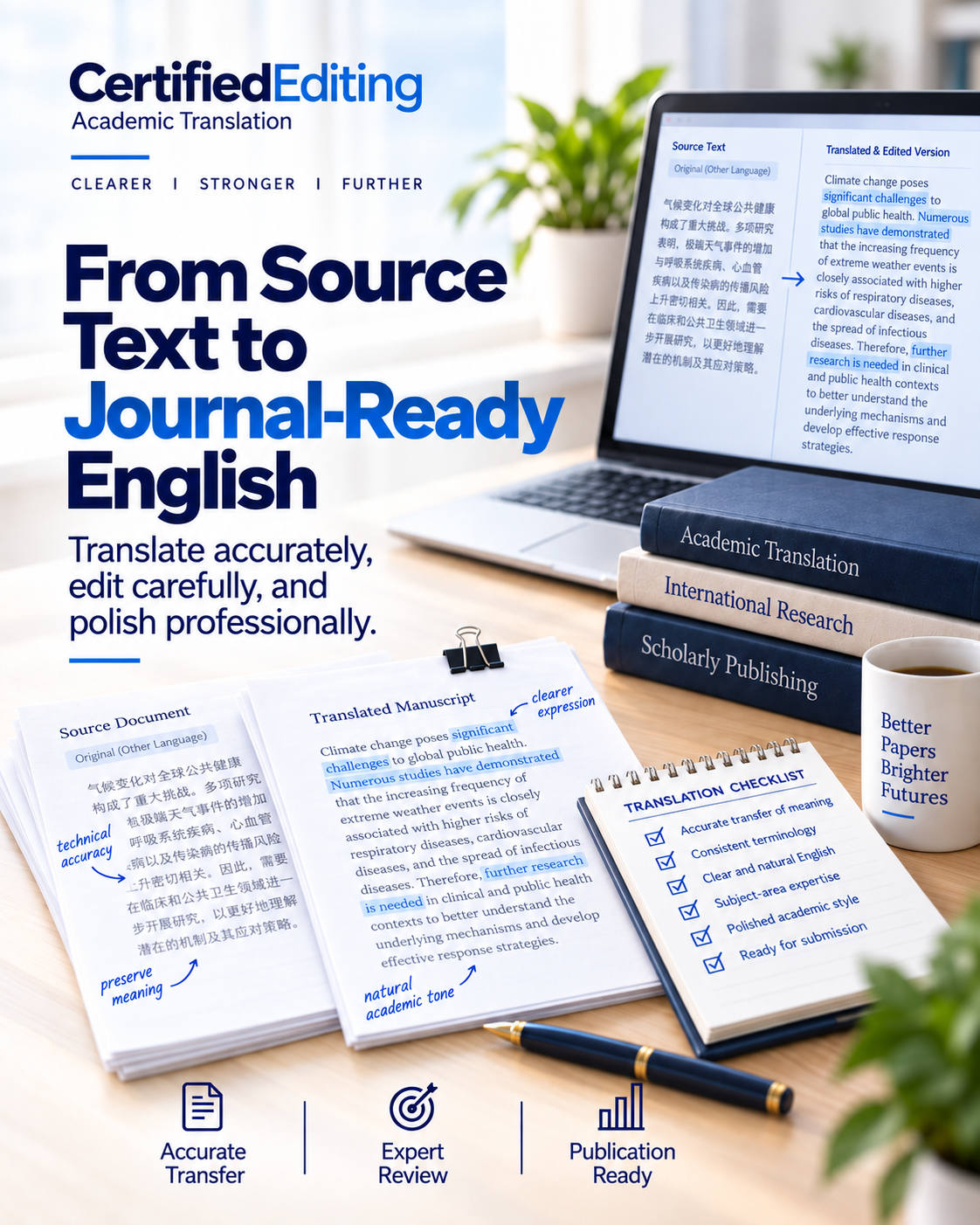
Before Translation Begins
Before translation begins, we review the final manuscript, its academic field, document type, target journal, preferred variety of English, and required delivery date. If tables, figure captions, supplementary files, ethics documents, cover letters, or responses to reviewers also require translation, these are clearly listed in the agreed scope of work. If you have preferred terminology, an approved term list, or specific requirements from your target journal, you can provide them before work begins.
This review helps us choose the right translation approach and maintain consistent terminology throughout the manuscript. If a journal editor or reviewer later requests language revisions to a manuscript we translated, we provide those revisions at no additional charge, provided that the original scientific content has not been materially changed.
- 10% Off Your First Order
- Complimentary iThenticate Similarity Check
- QR-Verifiable Language Certificate
- Native English-Speaking Editors
ACADEMIC TRANSLATIONS
YEARS OF EXPERIENCE
NATIVE ENGLISH-SPEAKING EDITORS
SATISFIED CLIENTS
Our Quality Standards for Academic Translation
Our translation process is designed to balance scientific accuracy with natural academic English.
During translation and final review, we pay particular attention to:
- Preserving the scientific meaning and level of certainty expressed in the source text
- Using terminology established in the relevant academic literature
- Maintaining terminology consistently throughout the manuscript
- Accurately transferring numbers, units, abbreviations, tables, and figure captions
- Producing natural sentence structures in the target language
- Maintaining an appropriate academic tone
- Using language appropriate to the function of the Methods, Results, Discussion, and other manuscript sections
- Maintaining consistent American or British English according to your requirements
- Conducting academic editing and proofreading after translation
- Performing a final terminology, consistency, and document-integrity check
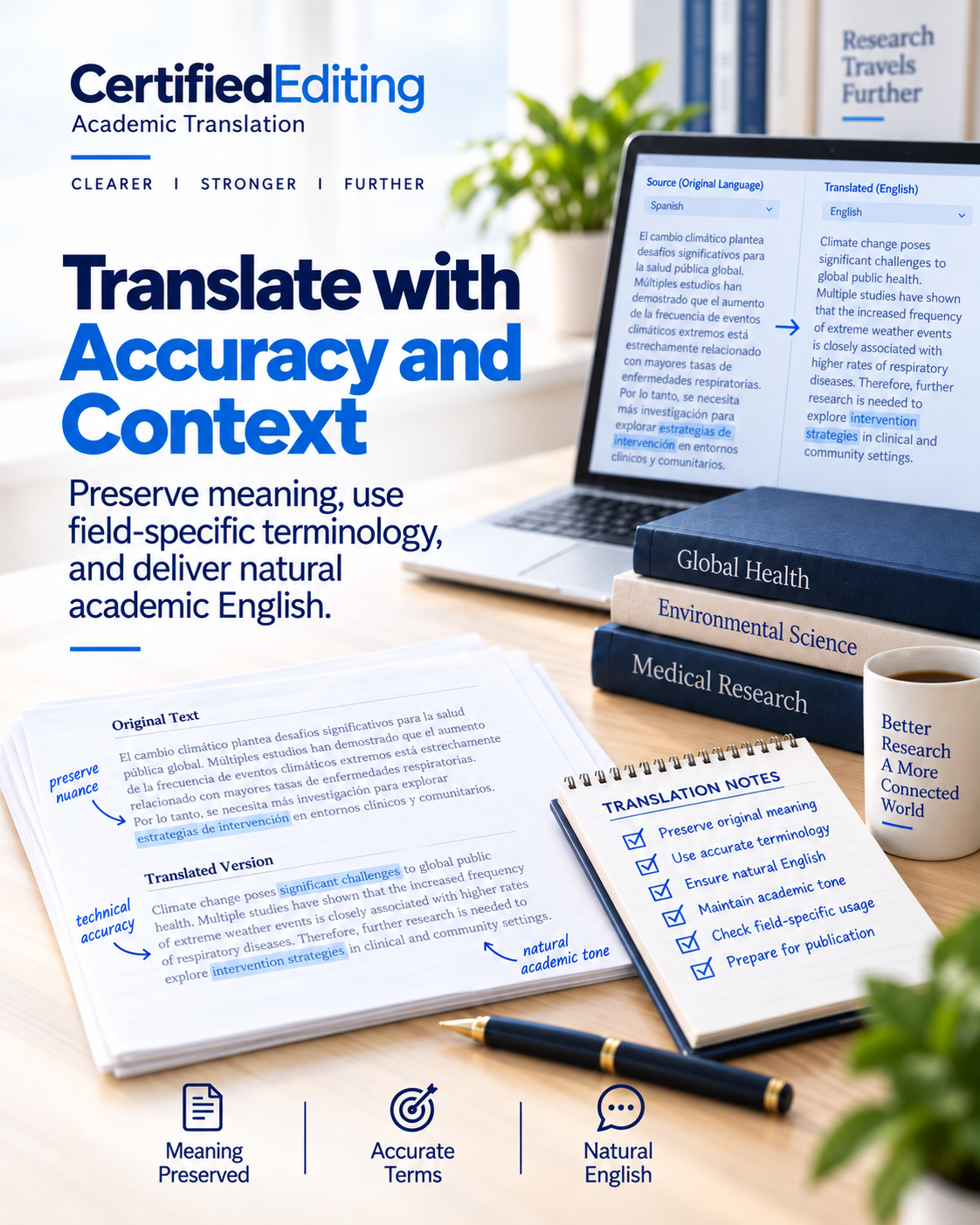
A final language review covering grammar, spelling, punctuation, fluency, and overall language quality.
A more comprehensive review of sentence structure, academic style, terminology, clarity, coherence, and overall flow.
Professional translation of your academic manuscript using terminology and conventions appropriate to the relevant scholarly literature, followed by academic editing.
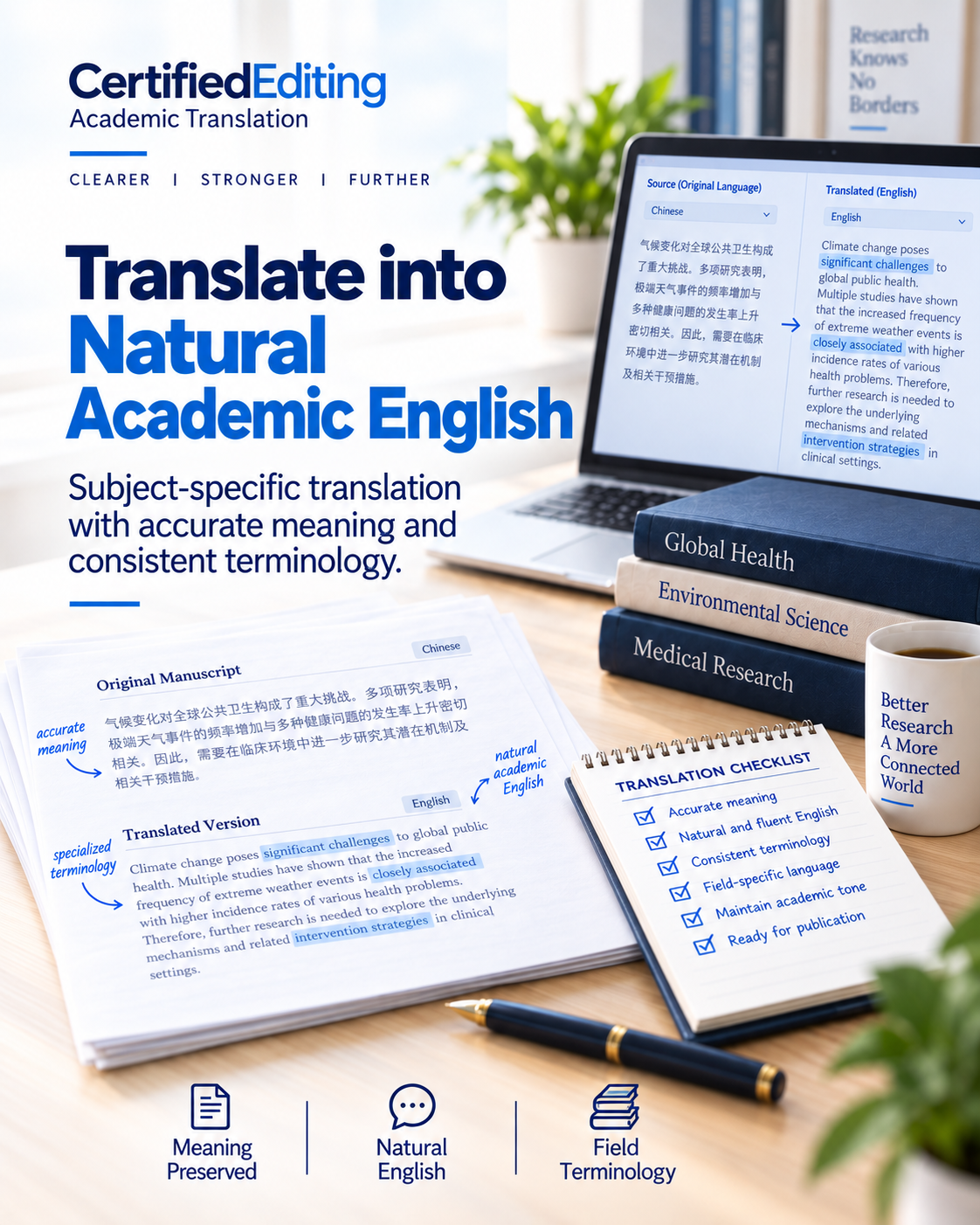
Accurate Translator and Editor Selection
Academic translation requires more than proficiency in two languages. Terminology, conventional expressions, and even sentence structures can vary considerably between medicine, engineering, natural sciences, social sciences, education, law, and other disciplines.
For this reason, your manuscript is assigned according to its academic field and specific subject. The initial translation is completed by a translator with experience in the relevant field. The English manuscript is then reviewed by a native English-speaking editor with appropriate academic and subject-area expertise. A final review focuses on terminology, consistency, language quality, and document integrity. This multi-stage process allows us to address both the accuracy of the translation and the naturalness of the final English manuscript.
Your Research Remains Confidential
Academic manuscripts may contain unpublished findings, original research ideas, personal information, institutional data, or other confidential material. Access to your files is therefore limited to the professionals assigned to your project. Your manuscript is not shared or used for purposes unrelated to the service you have requested. If the translator or editor encounters an expression that requires clarification, the relevant question is referred back to you rather than being resolved through an unsupported assumption. Your files and personal data are handled in accordance with applicable data protection requirements.
Frequently Asked Questions
What does your academic translation service include?
Our academic translation service covers the translation of scholarly documents such as research articles, review papers, theses and dissertations, conference papers, abstracts, project documents, cover letters, and responses to reviewers. The objective is not simply to replace Turkish words with their English equivalents. We translate the scientific meaning of the source text into clear and natural academic English while using terminology appropriate to the relevant international literature. Academic editing and proofreading are included after translation at no additional charge.
What is the difference between academic translation and general translation?
Academic translation requires more than knowledge of the source and target languages. The translator must also consider discipline-specific terminology, scientific context, academic conventions, manuscript structure, and the communicative function of individual sections. For example, the language used to describe methodology differs from the language typically used to present findings or discuss their implications. Academic translation therefore requires both accurate meaning transfer and familiarity with academic discourse in the relevant field.
Do you provide a language certificate?
Yes. A QR-coded language certificate that can be verified online is provided with our professional language services. The certificate can be used to document that your manuscript has undergone professional language processing when submitting it to a journal or academic organization.
Do you preserve the academic style of my manuscript?
Yes. Our primary objective is to preserve the scientific content and intended meaning of your manuscript while expressing them in natural academic English. Long or indirect sentences may need to be restructured to improve clarity and readability in English. However, your findings, scientific interpretations, arguments, and level of certainty are not changed.
Is academic editing necessary after translation?
Professional academic translation should include a separate language review after the initial translation. For this reason, manuscripts translated by CertifiedEditing undergo academic editing and proofreading at no additional charge. The translation is first checked for accuracy, meaning, terminology, and consistency. The English text is then reviewed for academic style, sentence structure, clarity, readability, grammar, and overall language quality.
What types of documents can you translate?
We translate a wide range of academic documents, including research articles, review papers, case reports, theses and dissertations, conference papers, abstracts, ethics committee documents, cover letters, responses to reviewers, academic CVs, technical reports, books, and book chapters. The translation strategy is adapted to the type and purpose of each document.
How do you handle technical and discipline-specific terminology?
Terminology consistency is one of the most important elements of academic translation. Terms in medicine, engineering, education, social sciences, natural sciences, and other disciplines are translated with reference to their established usage in the relevant academic literature. If you have terminology that you have used in previous publications, a preferred terminology list, or expressions specifically required by your target journal, you may provide these before translation begins.
Is every sentence translated literally?
No. Literal translation often produces unnatural or unclear academic English. The objective of academic translation is to transfer the meaning accurately rather than reproduce word order or sentence structure. Long, indirect, or repetitive structures may therefore be reorganized when necessary to produce clearer academic English, provided that the scientific meaning remains unchanged.
Will you change my scientific claims when translating them?
No. The level of certainty expressed in the source manuscript is preserved. For example, a statement indicating that a finding “may suggest” an association should not become a definitive statement that the finding “demonstrates” or “proves” that association. This distinction is particularly important in academic translation because even small linguistic changes can alter the strength of a scientific claim.
Can you translate my manuscript into American English?
Yes. Unless you request otherwise, we can prepare your manuscript in American English. If your target journal requires British English or follows a particular language convention, please provide this information before translation begins. The selected variety of English is then applied consistently throughout the manuscript.
Can you follow the terminology used by my target journal?
Yes. If you provide the name of your target journal before the project begins, its terminology and language preferences can be taken into consideration where relevant. You can also provide previously published papers, terminology lists, or your own earlier publications as references for preferred terminology.
Does academic translation guarantee acceptance by a journal?
No. Professional academic translation improves the linguistic presentation, clarity, terminology, and readability of your manuscript. Journal acceptance, however, depends on many factors beyond language, including originality, scientific contribution, research design, methodology, statistical analysis, relevance to the journal’s scope, and peer review. No language service can guarantee acceptance or publication.
What should I do before submitting my manuscript for translation?
Whenever possible, submit a version that is close to final in terms of scientific content. The title, abstract, main text, tables, figure captions, references, and supplementary material should ideally be complete. You should also provide:
- Your target journal, if already selected
- Any relevant word limits
- Your preferred variety of English
- Any terminology preferences
- Any special instructions
- Your required delivery date
Providing this information before translation begins helps us plan the project more accurately.
How do you protect the confidentiality of my manuscript?
Access to your manuscript is restricted to the professionals assigned to your project. Academic documents may contain unpublished data, personal information, institutional information, and original scientific ideas. For this reason, your files are handled according to applicable data protection requirements and are not shared for purposes unrelated to the service you have requested.