Clearer, More Natural Academic English Without Changing Your Meaning
Academic English Editing
Save 10% on your first order
Academic editing goes beyond correcting grammar, spelling, and punctuation. It improves sentence structure, word choice, academic tone, clarity, terminology, and the overall flow of your manuscript. The goal is not to change your scientific content, but to express your existing ideas in clear, natural, and consistent academic English. Your manuscript is assigned to a native English-speaking editor with expertise relevant to your field. The editor improves clarity, readability, and academic style while preserving your intended meaning and scientific content.
Our academic editing service also includes a complimentary iThenticate similarity check and a QR-verifiable language certificate.
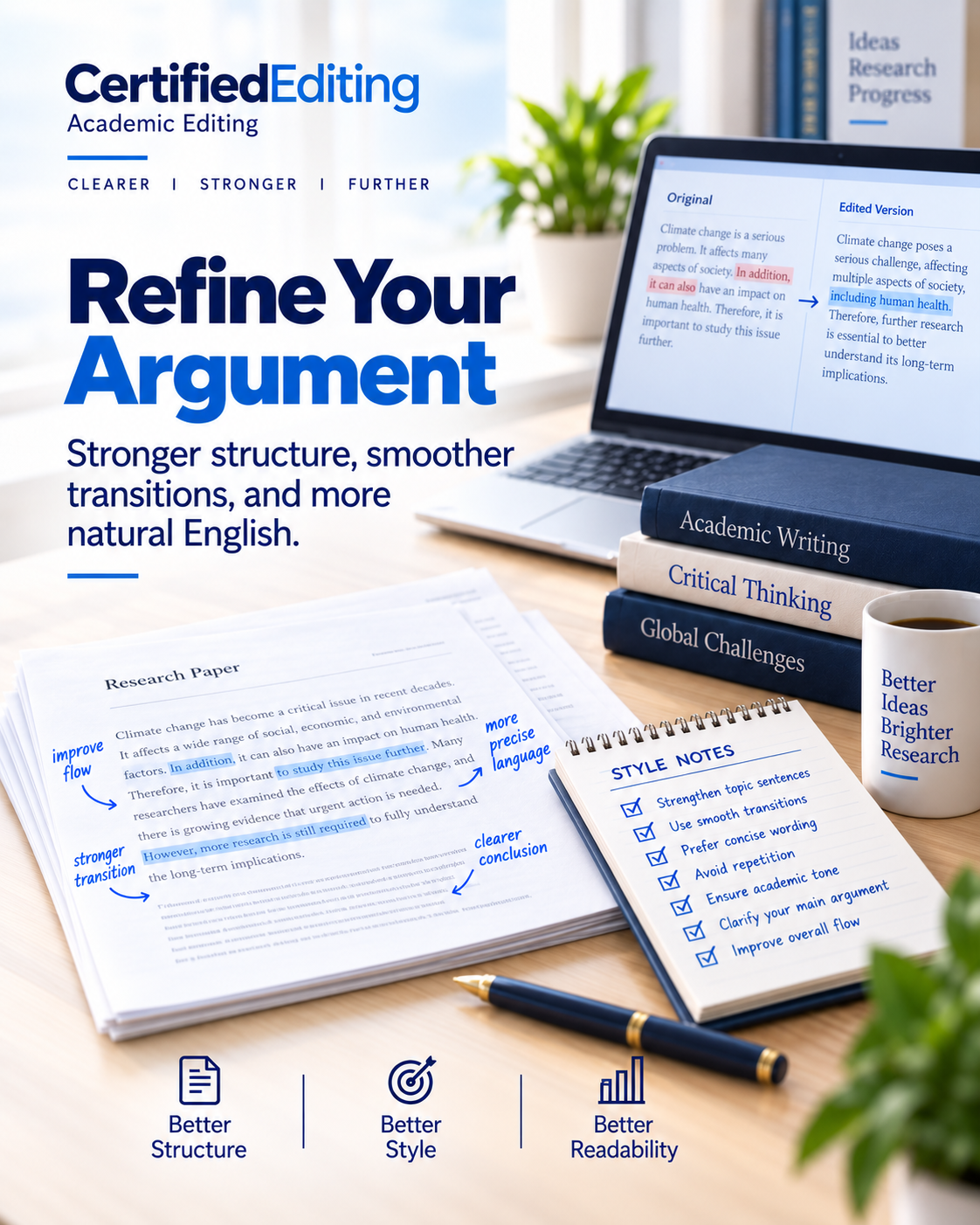
What Is Academic Editing?
Academic editing goes beyond correcting spelling and grammar. We review sentence structure, academic style, word choice, terminology, clarity, paragraph transitions, and overall flow. We do not alter your scientific content or research findings. Instead, we help you communicate them in clear, natural academic English appropriate for journal submission. Throughout the process, we preserve your intended meaning, scholarly voice, and discipline-specific terminology.
For many researchers, academic editing is more than a final language check. It is an important step in preparing a manuscript for submission to an international journal. If a journal editor or reviewer later requests language revisions to a manuscript we have edited, we provide those revisions at no additional charge, provided that the original scientific content has not been materially changed.
- 10% Off Your First Order
- Complimentary iThenticate Similarity Check
- QR-Verifiable Language Certificate
- Native English-Speaking Editors
ACADEMIC TRANSLATIONS
YEARS OF EXPERIENCE
NATIVE ENGLISH-SPEAKING EDITORS
SATISFIED CLIENTS
When Is Academic Editing the Right Choice?
Academic editing may be the right choice if your manuscript needs more than a final grammar and spelling check. It is particularly useful for:
- Manuscripts written in English that still need substantial language refinement
- English manuscripts that read like literal translations from another language
- Manuscripts for which an editor or reviewer has requested substantial language revision
- Multi-author manuscripts that need consistent language and style across sections
- Manuscripts that are grammatically correct but still lack clarity, flow, or an appropriate academic tone
- Manuscripts written, translated, or revised with AI tools
- Manuscripts with repetitive wording, mechanical phrasing, or inconsistent style across sections
What Do We Edit in AI-Assisted Academic Manuscripts?
A manuscript edited with AI may be grammatically correct while still containing repetitive sentence patterns, unnecessary generalizations, mechanical phrasing, or wording that does not fit the academic context.
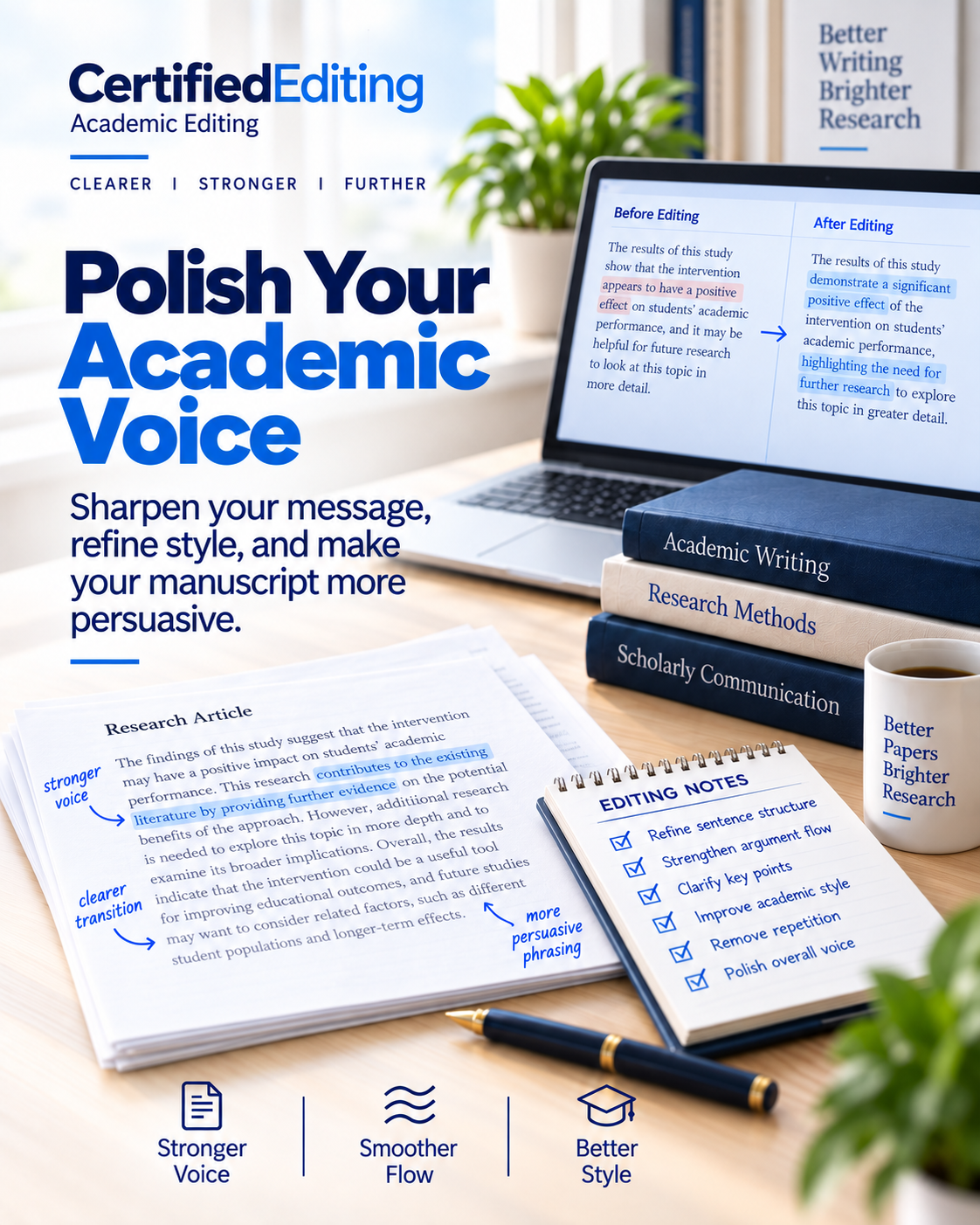
A final language review covering grammar, spelling, punctuation, fluency, and overall language quality.
A more comprehensive review of sentence structure, academic style, terminology, clarity, coherence, and overall flow.
Professional translation of your academic manuscript using terminology and conventions appropriate to the relevant scholarly literature, followed by academic editing.
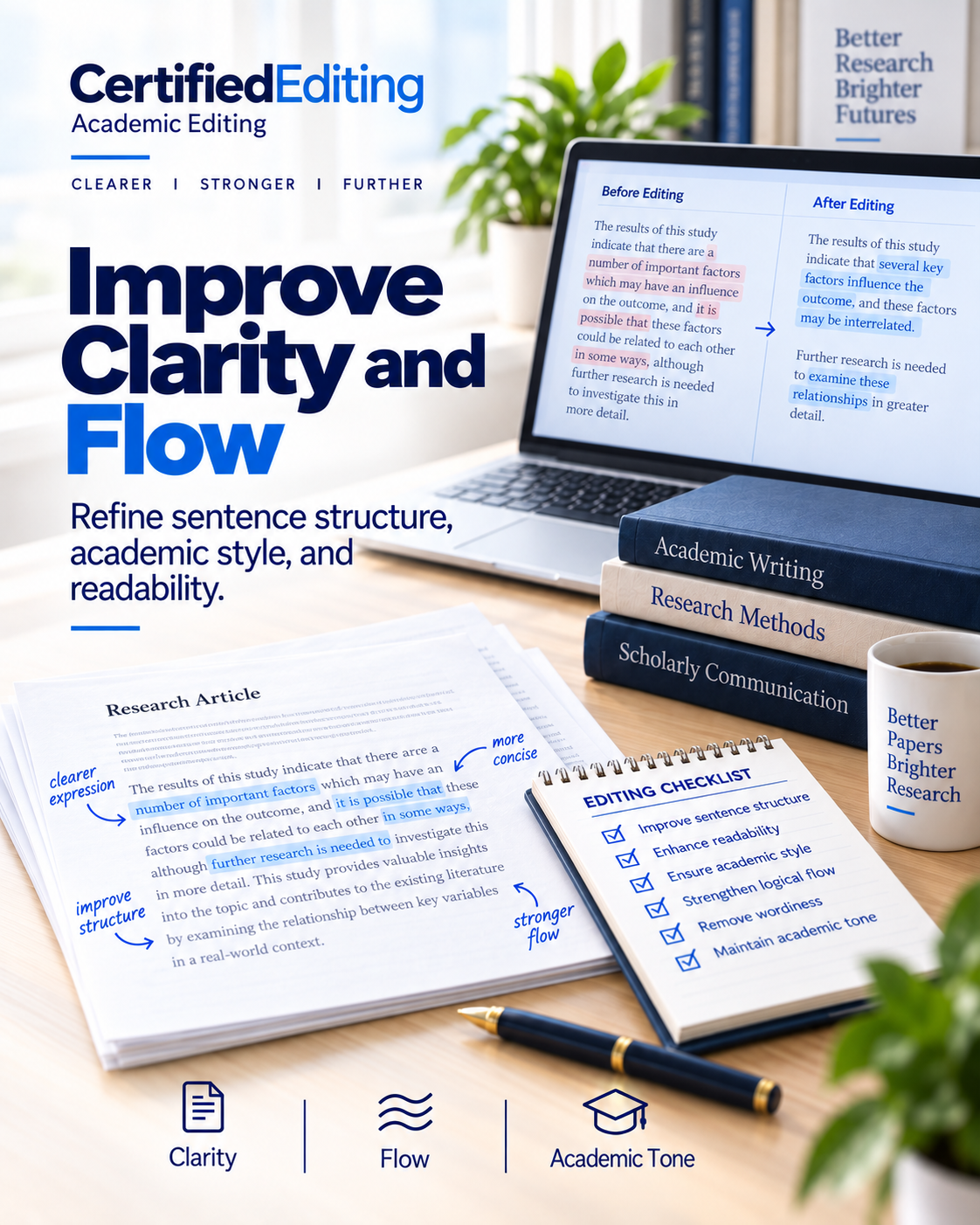
How Do We Preserve Your Meaning?
Before making substantial language changes, the editor reads the manuscript as a whole to understand the purpose of the research, its central concepts, and the way the argument is developed. All revisions are made within this context. If a sentence or expression could reasonably be interpreted in more than one way, the editor does not guess what the author intended. Instead, a comment is added so that the academic decision remains with the author. Research data, findings, references, and scientific interpretations are not changed as part of academic editing.
Subject-Specific Editor Matching
The same term may carry different meanings in medicine, engineering, natural sciences, social sciences, education, law, and other disciplines. For this reason, we review the subject of your manuscript and, where applicable, your target journal before assigning an editor. Your manuscript is matched with a native English-speaking editor who has experience with academic texts in the relevant subject area and can work confidently with its terminology. If you have previously established terminology, a preferred terminology list, or specific language requirements from your target journal, you may provide these before editing begins.
Frequently Asked Questions
What exactly does academic editing include?
Academic editing improves an English-language scholarly manuscript in terms of language, clarity, readability, academic style, terminology consistency, and sentence structure. The process goes beyond correcting spelling and grammar. Sentences and paragraphs are refined where necessary so that the manuscript reads more naturally and communicates its content more clearly in an academic context. Your research findings, scientific interpretations, and substantive content are preserved.
What is the difference between editing and proofreading?
Academic editing involves more substantial language improvement. It addresses sentence structure, academic expression, word choice, clarity, flow, and terminology. Proofreading is generally performed at a later stage and focuses primarily on grammar, spelling, punctuation, minor language errors, and consistency. If your manuscript requires significant improvement in clarity or academic expression, editing is usually the more appropriate service. If the English is already strong and only a final language check is required, proofreading may be sufficient.
Do you provide a language certificate?
Yes. A QR-coded language certificate that can be verified online is provided with our professional language services. It can be used to document that the manuscript has undergone professional language review when submitting it to a journal or academic organization.
Will my academic writing style be preserved?
Yes. The objective of academic editing is not to replace your scholarly voice or scientific approach. We preserve your intended meaning and writing style as far as possible while improving expressions that may sound unnatural, unclear, repetitive, or inconsistent with conventional academic English. The result should still represent your research and your academic voice.
Does academic editing guarantee journal acceptance?
No. Academic editing improves the linguistic quality, clarity, and readability of your manuscript, but publication decisions depend on many other factors, including originality, methodological rigor, scientific contribution, statistical analysis, journal scope, and peer review. Professional editing can help address language-related problems, but it cannot guarantee acceptance by a journal.
Do you edit manuscripts revised in response to reviewer or editor comments?
Yes. We can edit manuscripts that have been revised following comments from reviewers or journal editors. Particular attention can be given to newly added paragraphs, revised sections, modified sentences, and your response-to-reviewers letter so that the language remains consistent throughout the revised submission.
Which academic disciplines do you provide service for?
We provide academic editing for manuscripts in a wide range of disciplines, including:
- Medicine and health sciences
- Social sciences
- Education
- Engineering
- Natural sciences
- Humanities
- Law
- Interdisciplinary research
Accurate terminology is particularly important in academic publishing. For this reason, information about your manuscript’s subject area and target journal helps us assign the most appropriate editor.
Is the manuscript edited by a native English speaker?
Yes. Our academic editing is carried out by professional native English-speaking editors with at least seven years of professional experience. Manuscripts are assigned according to subject area so that both academic language and discipline-specific terminology can be addressed appropriately.
Can I see what has been changed after editing?
Yes. You can review the changes made to your manuscript by comparing the original and edited versions in Microsoft Word. We can provide a comparison document showing which sentences and expressions have been revised. Comments may also be added where clarification or an academic decision from the author is required.
Can you edit my manuscript according to the English style required by my target journal?
Yes. If your target journal specifies American English, British English, or particular language and style preferences, please provide the relevant information when submitting your manuscript. You may also provide the name of your target journal so that its language requirements can be taken into account during editing.
When should I submit my manuscript for academic editing?
We recommend submitting your manuscript once the main text, tables, figure captions, and references are substantially complete. If major content changes are still expected, extensive revisions made after editing may introduce new language inconsistencies. For the most efficient process, the version submitted for editing should therefore be as close as possible to the version you intend to submit to the journal.
Can I request another language check after editing?
Yes. If a journal editor or reviewer requests language revisions after our editing service, we can review the relevant language changes again, provided that the original scientific content has not been substantially changed. New sections, major additions, or work falling outside the original scope may be evaluated separately.
How is editing of AI-assisted manuscripts priced?
The cost is determined considering the length of the manuscript, its current language quality, and the extent of editorial intervention required. If additional work such as comparison with the original source text is required, this will be clearly identified in your quotation before work begins.
Do you guarantee a specific AI-detection score after editing?
No. We do not guarantee any specific score from AI-detection software. Our editing service focuses on improving academic language, clarity, naturalness, consistency, and discipline-specific terminology. Professional editing also does not replace any disclosure regarding AI use that may be required by your institution, publisher, or target journal.