Final Language Review for Submission-Ready Manuscripts
Academic Proofreading Services
Save 10% on your first order
Even after several rounds of revision, small language errors can be easy to miss. An incorrect preposition, inconsistent verb tense, or mismatch between a table heading and the main text may only become apparent during a final review. Our academic proofreading service is intended for English manuscripts that are already well written and close to completion.Our proofreading service also includes a complimentary iThenticate similarity check and a QR-coded language certificate that can be verified online.
We review the manuscript from beginning to end, correct language errors, and check consistency across the document. If our initial assessment shows that the manuscript needs substantial sentence-level revision rather than proofreading alone, we will let you know before work begins and recommend the appropriate level of editing.
Our proofreading service also includes a complimentary iThenticate similarity check and a QR-verifiable language certificate.
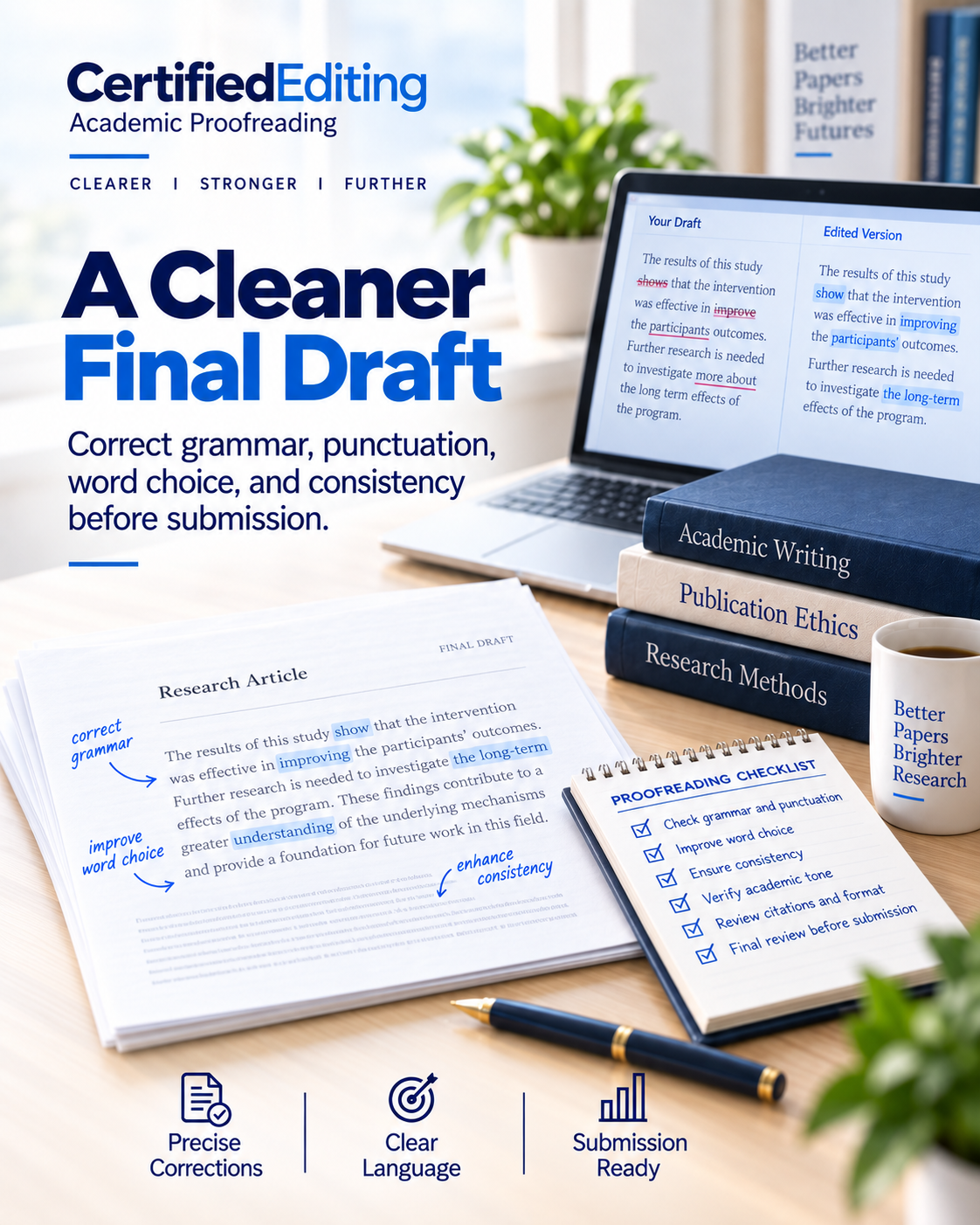
What Does Academic Proofreading Cover?
We review your manuscript as a whole, not just sentence by sentence. We also check terminology, abbreviations, spelling conventions, and word choice across the document to maintain consistency.
We check:
- Spelling, punctuation, and capitalization
- Grammar, subject–verb agreement, and verb tense
- Prepositions, articles, and singular/plural forms
- Minor wording issues that may affect clarity
- Consistency in American or British English
- Consistent use of terminology and abbreviations
- Consistent presentation of numbers and units
- Language in tables, figure captions, and appendices included within the agreed scope of service
If a passage is ambiguous and a change could affect the intended meaning, we flag it for clarification rather than guessing.
Your research data, findings, and scientific interpretations remain outside the scope of language proofreading.
- 10% Off Your First Order
- Complimentary iThenticate Similarity Check
- QR-Verifiable Language Certificate
- Native English-Speaking Editors
ACADEMIC TRANSLATIONS
YEARS OF EXPERIENCE
NATIVE ENGLISH-SPEAKING EDITORS
SATISFIED CLIENTS
Is Your Manuscript Suitable for Proofreading?
Proofreading is usually the right choice when your manuscript is already clear, well structured, and close to its final version.
Proofreading is commonly used for:
- Original research articles and review papers intended for journal submission
- Academic manuscripts that have previously been translated or edited
- Master’s theses and doctoral dissertations
- Academic books and book chapters
- Conference papers and abstracts
- Cover letters and responses to reviewers
- Manuscripts updated following peer-review revisions
If you are unsure whether proofreading is sufficient, send us the manuscript for a free assessment. We will review its current language quality and let you know whether proofreading or more comprehensive academic editing would be more appropriate.
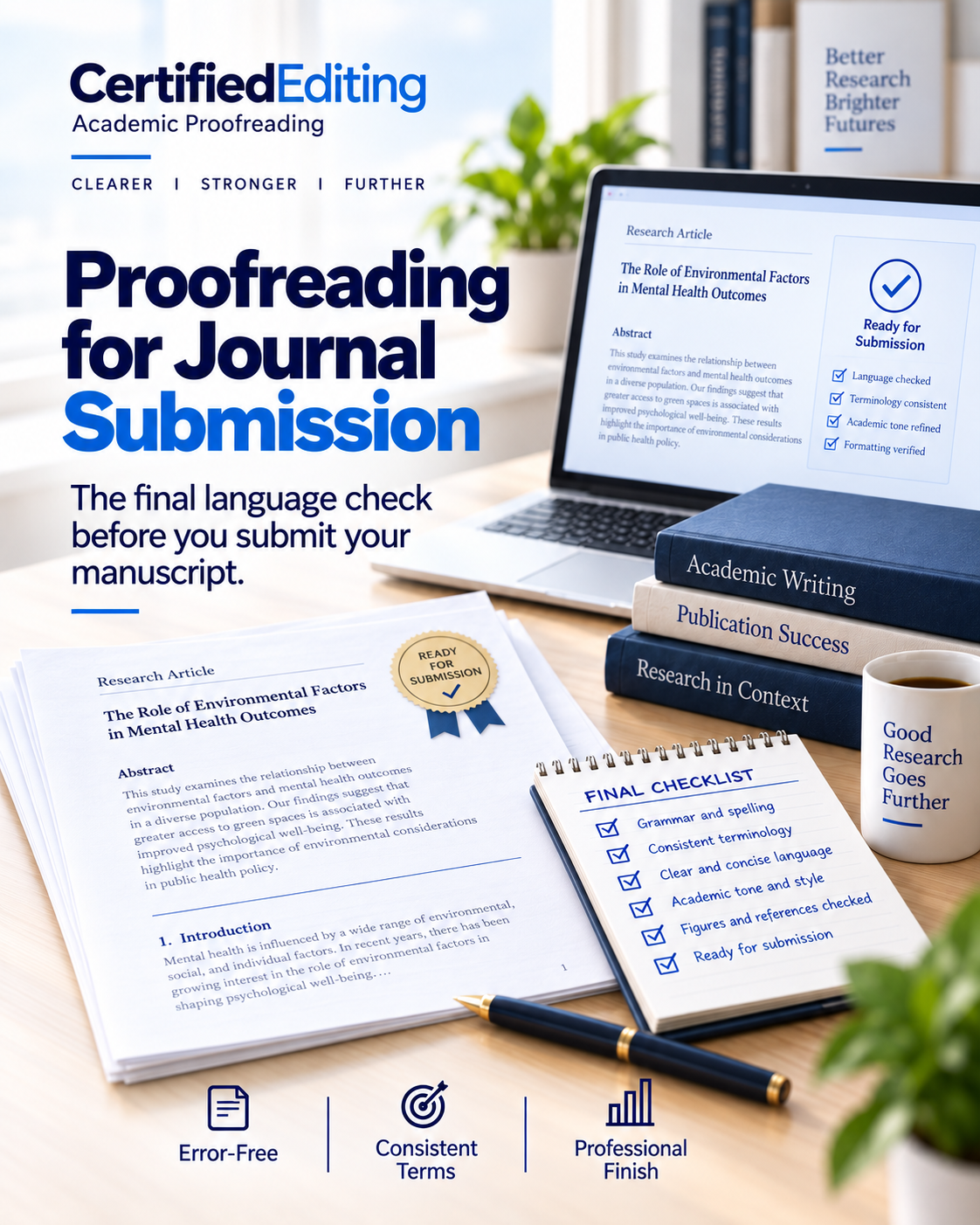
A final language review covering grammar, spelling, punctuation, fluency, and overall language quality.
A more comprehensive review of sentence structure, academic style, terminology, clarity, coherence, and overall flow.
Professional translation of your academic manuscript using terminology and conventions appropriate to the relevant scholarly literature, followed by academic editing.
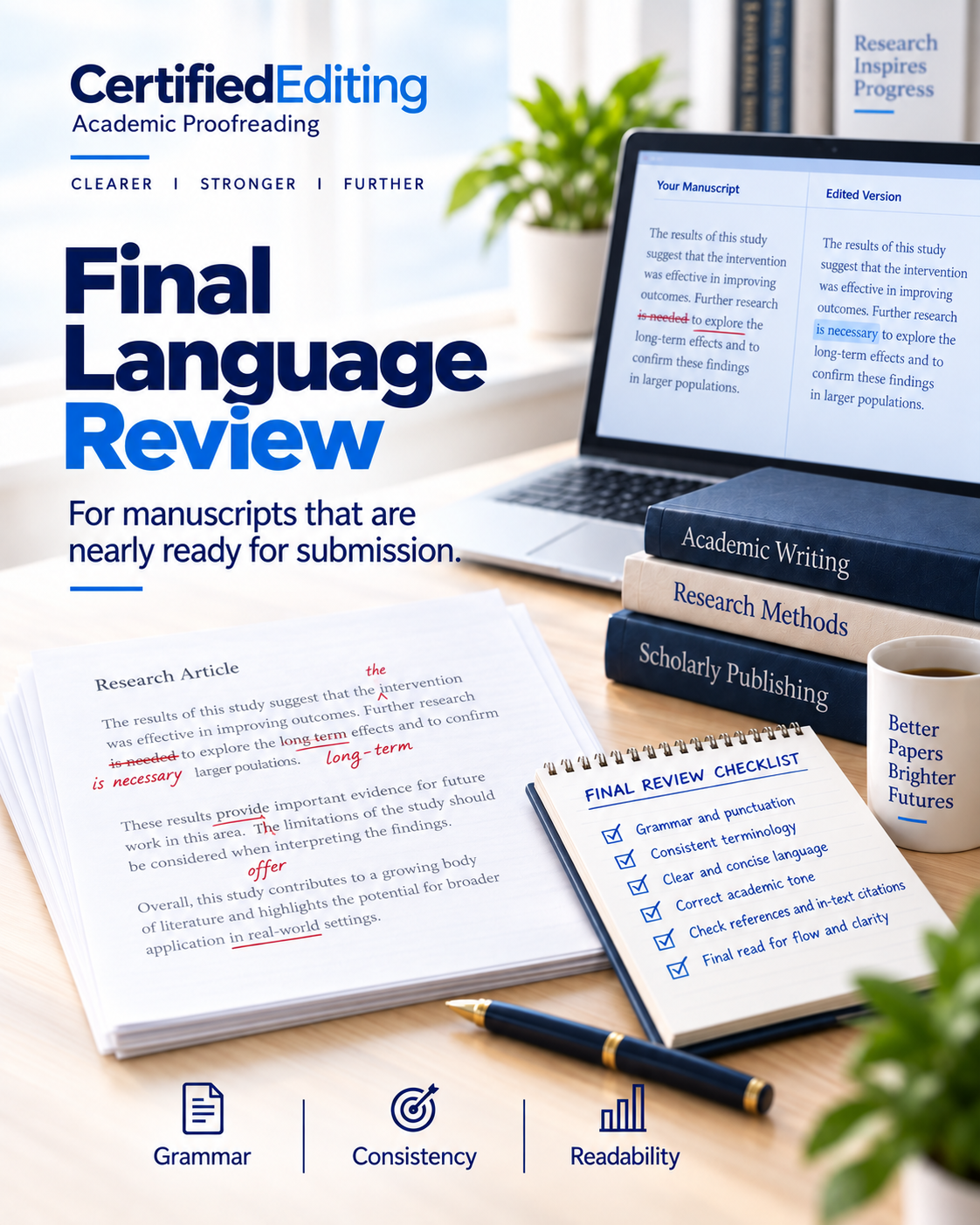
Final Review for AI-Assisted Manuscripts
If your manuscript has been translated or edited with an AI tool, a professional language review may still be useful for identifying problems with wording, grammar, terminology, and consistency.
The appropriate service depends on the manuscript’s current language quality, not on how the text was produced.
If only minor language errors remain, proofreading may be sufficient. If the manuscript contains mechanical phrasing, repetitive sentence patterns, unnatural wording, or sentences that need substantial revision, academic editing will usually be more appropriate.
If you would like us to compare an AI-assisted English translation with the original Turkish text, mention this when requesting your quotation. Source-text comparison will be listed separately in the proposed scope of work.
How Does the Proofreading Process Work?
- We review your manuscript free of charge to determine whether proofreading is appropriate for its current language level.
- We note your target journal, preferred variety of English, field-specific terminology, and any special requirements before assigning the manuscript to an editor.
- The editor reviews the manuscript from beginning to end. If a passage is ambiguous and could affect meaning, the editor flags it for clarification rather than making an assumption.
- The revised manuscript then undergoes a final consistency check, and the similarity level is reviewed before delivery.
Frequently Asked Questions
What does academic proofreading include?
Academic proofreading is the final language review of an English academic manuscript. It includes the correction of spelling, punctuation, grammar, word usage, minor clarity issues, inconsistencies, and other language-level problems. Rather than extensively rewriting entire sentences or restructuring the manuscript, proofreading is intended to provide a careful final review before submission.
When should proofreading be performed?
Proofreading is most effective when the manuscript is close to its final version. Ideally, the title, abstract, main text, tables, figure captions, and references should already be substantially complete before proofreading begins. If significant new content is added after proofreading, the newly added sections should also undergo language review.
Do you provide a language certificate?
Yes. A QR-coded language certificate that can be verified online is provided with our professional language services. The certificate can be used to document that your manuscript has undergone professional language review when submitting it to a journal or academic organization.
What is the main difference between proofreading and editing?
Proofreading is a more limited service focused primarily on the final stage of manuscript preparation. Its main purpose is to identify and correct minor language, grammar, spelling, punctuation, and consistency issues. Academic editing is more comprehensive. It may involve substantial improvements to sentence structure, academic style, clarity, terminology, word choice, and overall flow. If your manuscript contains significant problems with expression or readability, academic editing may be more appropriate than proofreading.
Is my manuscript suitable for proofreading?
Your manuscript is generally suitable for proofreading if it is already understandable, written in reasonably strong academic English, and close to completion. If it contains frequent grammatical errors, unnatural expressions, literal translations from Turkish, poor flow, or sentences that are difficult to understand, proofreading alone may not be sufficient. In such cases, we may recommend academic editing after reviewing the manuscript.
Does proofreading improve the academic quality of my manuscript?
Proofreading improves the linguistic presentation of your manuscript by making the language cleaner, more accurate, and more consistent. Its scope, however, is more limited than academic editing. Proofreading does not restructure your argument, redesign your methodology, reinterpret your findings, or reorganize the scientific content of your paper. It is therefore most appropriate as a final language check before submission.
Will proofreading change the meaning of my manuscript?
No. The author’s intended meaning is preserved throughout the proofreading process. Most changes involve grammar, spelling, punctuation, minor word choices, and sentence-level readability. If an expression is ambiguous and changing it could alter the intended meaning, the editor may leave a comment asking for clarification rather than making an assumption.
Is proofreading sufficient before submitting my manuscript to a journal?
It depends on the current quality of the manuscript. If your paper has already been professionally translated or edited and only requires a final language check, proofreading may be sufficient. If the manuscript has not previously undergone professional language editing, contains weak English, or has received substantial comments such as “language editing required” from reviewers or editors, academic editing may be more appropriate.
Can I use proofreading after making revisions requested by reviewers?
Yes. Proofreading can be particularly useful after peer-review revisions when new sentences, paragraphs, explanations, or analyses have been added to the manuscript. The review helps ensure that the newly added material is linguistically consistent with the rest of the paper. You may also request proofreading of your response-to-reviewers letter together with the revised manuscript.
How is the proofreading turnaround time determined?
Turnaround time depends on several factors, including the word count, technical complexity of the manuscript, its current language quality, and the extent of the requested review. Shorter manuscripts can generally be reviewed more quickly, while longer papers or documents containing numerous tables, figures, and appendices may require additional time. For academic proofreading, a careful final review is as important as turnaround speed. Your confirmed delivery date will therefore be specified in your quotation before work begins.
Is proofreading sufficient for a manuscript prepared using AI?
It depends on the current condition of the manuscript. If the manuscript only contains minor language errors, proofreading may be sufficient. If it contains mechanical phrasing, repetitive sentence structures, unnatural expressions, or sentences requiring substantial rewriting, academic editing will usually be more appropriate.
Do you guarantee a specific result from AI-detection tools?
No. Our services are not provided on the basis of achieving a specific AI-detection score. Professional language editing or proofreading also does not replace any AI-use disclosure that may be required by your institution, publisher, or target journal.
Does proofreading guarantee that my manuscript will be accepted by a journal?
No. Proofreading helps ensure that your manuscript is presented in clear, accurate, and consistent English. The final publication decision is made independently by the journal and depends on factors such as the scientific quality of the research, originality, methodological rigor, relevance to the journal’s scope, and peer-review process. No professional language service can guarantee journal acceptance.